Artificial Intelligence
AI Automation for Business: Customer Support and Workflow Planning
Plan AI automation for customer support, document processing and business workflows with practical examples, human review and measurable pilot criteria.
In this article
AI automation is most useful when it supports a clearly defined task inside a controlled workflow. It is less useful when a team adds a chatbot without deciding what it can access, which actions it may take, and who handles mistakes. Start with one operational problem and a way to evaluate the result.
This article distinguishes deterministic automation from AI-assisted decisions and suggests a bounded pilot. It does not promise a particular productivity gain or imply that every process needs an AI model.
Separate rules from interpretation
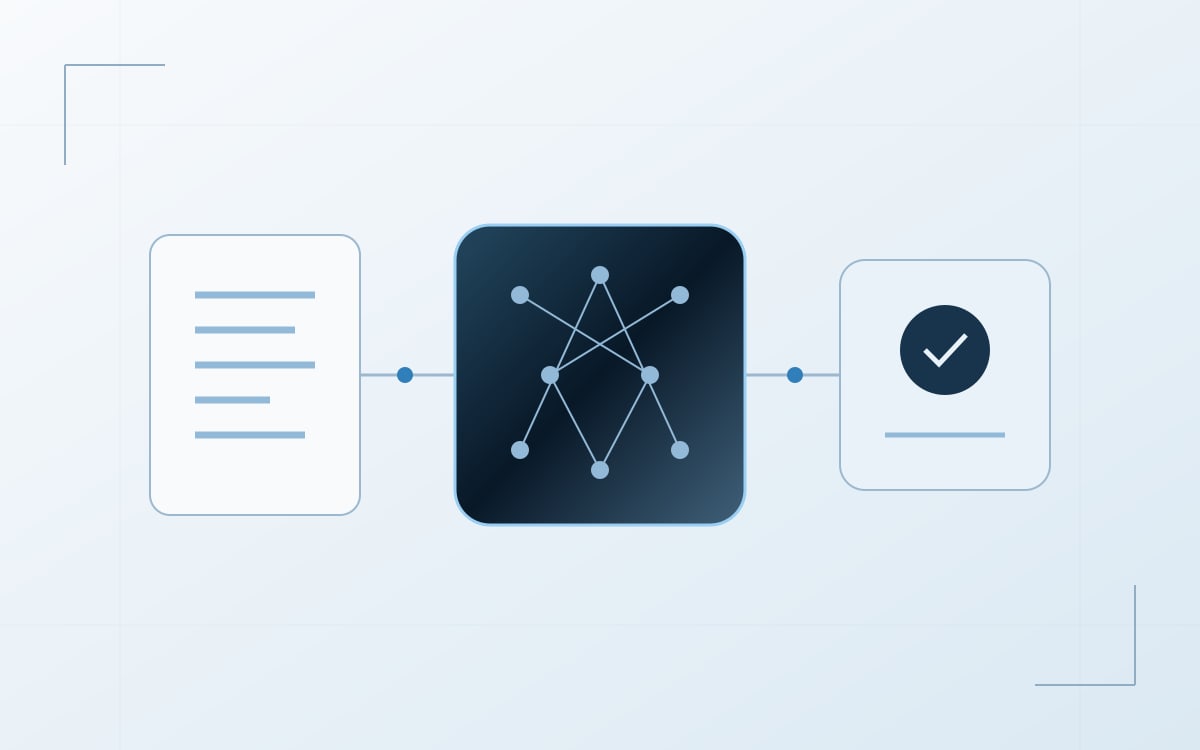
Traditional automation follows explicit conditions: validate a required field, route an approved request or send a reminder. An AI model can help interpret less structured inputs, such as a document or a free-text inquiry, but its output may be incomplete or incorrect.
Use ordinary rules where the process is predictable. Add a model only where interpretation creates a meaningful benefit, and keep the surrounding controls explicit. A model should not quietly decide what counts as an authorized action.
Choose a manageable first workflow
Look for repetitive work with defined inputs, a measurable outcome and an affordable review process. Candidate tasks include sorting support inquiries, drafting internal replies or suggesting fields extracted from documents.
An illustrative pilot could classify incoming service requests and suggest a queue while a person confirms routing. That is different from automatically making commitments to customers. Map unusual cases and decide where the workflow must stop for human assistance.
Define the assistant's boundaries
Specify the information an assistant can retrieve, which sources are authoritative and when it should acknowledge uncertainty. If it drafts a response, show its source context to the reviewer where practical.
Separate read access from write actions. Looking up an order is a different permission from changing delivery details. Start with the smallest useful permissions, and require explicit approval for consequential changes. Test attempts to steer the assistant away from the intended task.
Build document workflows with review points
Document extraction should produce proposed data, not silently replace trusted records. Validate required fields, compare totals or identifiers where appropriate, and route uncertain or contradictory results to a person.
Preserve a link to the source document and record corrections. Evaluate representative formats, poor scans and edge cases before rollout. Avoid assuming that a convincing-looking output has been verified simply because it fits the expected structure.
Integrate with existing systems carefully
Decide which system owns each record and how updates are identified. Use documented interfaces, narrowly scoped credentials and explicit validation before a write. Define retry behavior so that a repeated request does not create duplicate work.
Keep an operational log appropriate to the task, with access restrictions and a retention plan. The integration must also handle a model service being unavailable. A manual queue may be a safer fallback than an unreviewed automatic response.
Treat privacy and oversight as design inputs
Identify what data leaves your environment, where it is processed, who can access it and how long it is retained. Check the actual provider terms and your organization's requirements before using customer or sensitive information.
The NIST AI Risk Management Framework provides a structured way to consider AI risks in context. Use it as a reference for evaluating and managing risk, not as proof that a chosen system is safe. This article is not a compliance certification.
Measure effectiveness against a baseline
Before the pilot, record the current task time, error patterns and review effort. During evaluation, examine accepted outputs, correction rates, escalations and the time spent checking results. Include model and integration costs.
Use a representative test set and keep examples separate from any material used to tune the workflow. A small set of successful demonstrations is not enough. Agree what counts as an improvement and what result would stop the pilot.
| Measure | Question to investigate |
|---|---|
| Task completion | Did the workflow solve the intended problem? |
| Correction burden | How much human work did the output create? |
| Failure recovery | Can staff identify and resolve errors? |
| Operational cost | Is the benefit worthwhile at expected usage? |
Know when not to automate
Avoid autonomous decisions where errors have consequences the organization cannot adequately review or reverse. Do not add AI to a process that lacks a clear owner or relies on unreliable source records.
A simpler form, better search or a rule-based integration may solve the problem more predictably. Bring a workflow map and safe sample inputs to an AI and automation consultation. A useful next step is a bounded experiment with an explicit human review plan.
Plan customer support automation around a service request
Consider an illustrative service desk. A customer writes a question, the workflow identifies its topic, retrieves an approved help article and prepares a proposed answer. A staff member can review uncertain cases and any reply involving an exception or a business commitment.
Define the escalation path before connecting a customer channel. Decide who receives a failed delivery, an unanswered question or a complaint. Keep the original message and the approved response together so the team can investigate recurring issues.
Questions about AI automation for companies
Which process is a good starting point?
Look for a repeated task with accessible source information, a defined owner and an outcome that people can check. Classifying service requests or preparing a reply draft can provide a manageable evaluation scope.
Can AI work with an ERP or accounting system?
Documented APIs and appropriate permissions can support an integration. First establish the source of truth for each record. The ERP selection guide includes a checklist for data ownership, integration and reconciliation.
How should we calculate the operating budget?
Include model usage, hosting, integration maintenance, monitoring and staff review. Estimate normal and peak demand, then compare the full workflow cost with the existing process. A mobile interface introduces a separate set of requirements covered in our mobile application planning guide.
Sources and editorial note
The framework and examples are general engineering suggestions, not measured client outcomes. The NIST AI RMF was reviewed on 7 November 2026. Provider terms, applicable privacy requirements and risk acceptance must be checked for the actual deployment.